
Can Veneers Fix Crooked Teeth? Your Guide to Veneers in Sydney
Do slightly crooked teeth make you feel a little shy about smiling in photos? You are certainly not the only person who has wondered whether veneers can fix that problem without going through years of braces, and this is honestly one of the most common questions people ask us during a consultation for cosmetic dentistry in Sydney. The short answer is that it really does depend on your situation, because veneers work beautifully for some smiles and are simply not the right tool for others. In this guide, we will walk you through when dental veneers genuinely help with crooked teeth, how they compare with a treatment like Invisalign®, and how a dentist decides which option suits your smile. By the end, you should feel confident about what questions to ask when you visit a dentist near you in Sydney for veneers.
What Are Dental Veneers?
A dental veneer is a thin, custom-made shell that a dentist bonds carefully onto the front surface of your tooth. Rather than rebuilding the whole tooth, a veneer simply resurfaces the part that people actually see when you smile, which is why it can make such a noticeable difference to the way your teeth look. Veneers can change the shape, colour, size and overall appearance of a tooth, and most people find the results look remarkably natural once everything settles into place.
There are two main types of veneers, and they tend to suit different budgets and different smile goals. Porcelain veneers are made from dental ceramic in a laboratory before being bonded onto your teeth, and because porcelain resists staining and reflects light in a similar way to natural enamel, these veneers often last somewhere between ten and fifteen years when they are looked after well.
Composite veneers, on the other hand, are built up directly on the tooth using a tooth-coloured resin, which usually means they can be completed in a single visit. They tend to cost less than porcelain and are easier to repair if something chips, although they generally last around five to seven years rather than a decade or more.
It is also worth knowing that modern veneers are far more conservative than the veneers dentists used many years ago. Many cases today need very little enamel removed, or sometimes none at all, which helps protect as much of your natural tooth structure as possible.
Can Veneers Fix Crooked Teeth?
Here is the point that everything else in this guide really hangs on, so it is worth reading carefully. Veneers can disguise crooked teeth, but they cannot physically move a tooth into a new position. A well-designed veneer reshapes the visible surface of the tooth, and when a dentist plans this carefully, mildly crooked or uneven teeth can end up looking impressively straight. This is exactly why veneers for crooked teeth have become such a popular cosmetic solution for people with minor alignment concerns.
However, veneers cannot correct a bite problem, and they cannot reposition teeth that sit well out of place. If your teeth are significantly crowded or your bite does not line up properly, trying to hide that with veneers puts extra pressure on them, which usually makes them wear out or chip much sooner than they should. In cases like these, straightening your teeth first with orthodontic treatment gives you a healthier and longer-lasting result overall.
When Are Veneers Suitable for Crooked Teeth?
-
Mildly Crooked Teeth
For teeth that are only mildly crooked, veneers tend to work extremely well. Small overlaps, slightly rotated teeth, uneven edges and small gaps can often be disguised beautifully, giving you a straighter-looking smile without any teeth actually needing to move. Most of the veneer cases dentists see for crooked teeth fall into this mild category.
-
Moderately Crooked Teeth
When several teeth are moderately out of alignment, veneers alone are usually asking too much of the treatment. Trying to mask that level of misalignment often means removing more enamel than is ideal, or ending up with teeth that look bulky rather than natural. In these situations, a dentist will often recommend Invisalign® first to bring the teeth into a better position, followed by a small number of veneers afterwards to refine shape or colour where needed.
-
Severely Crooked Teeth
For teeth that are severely crooked, or where there is a noticeable bite problem, this becomes an orthodontic issue rather than a purely cosmetic one. Placing veneers over teeth like this tends to look unnatural and wear down faster, so proper alignment treatment needs to happen first in order to protect your long-term dental health.
What Smile Concerns Can Veneers Improve?
Beyond crooked teeth, veneers are genuinely versatile and can help with several other common concerns. Chipped or worn teeth, often caused by years of grinding or an old accident, can have their original shape and length restored. Discoloured teeth that do not respond well to whitening, such as staining from an old root canal or from tetracycline marks, can be covered effectively with veneers. Teeth with an uneven shape can be reshaped to bring better balance and proportion to your whole smile, and small gaps between teeth can be closed without needing to wait months for orthodontic movement.
Veneers vs Invisalign®: Which Treatment Is Right for You?
Veneers and Invisalign® solve genuinely different problems, so choosing between them really comes down to what your teeth actually need.
-
When Veneers May Be the Better Choice
Veneers tend to be the better choice when your main concern is cosmetic, such as tooth shape, colour, chips or only minor alignment issues, and because the treatment changes the surface of the tooth rather than moving it, results can often be finished in just two or three visits over a few weeks.
-
When Invisalign® May Be Recommended
Invisalign® is generally recommended when teeth genuinely need to move into a healthier position, and it can improve your bite without removing any enamel, although treatment usually takes somewhere between six and eighteen months to complete. If your teeth are structurally healthy but simply misaligned, straightening them first is often the better long-term choice.
-
Can Veneers and Invisalign® Be Combined?
In many cases, combining both treatments gives the best possible outcome. A dentist may use Invisalign® to straighten your teeth first, and then add a small number of veneers afterwards to refine colour, shape and symmetry. Because straighter teeth usually need fewer veneers and less enamel removal, this combined approach often protects more of your natural teeth while still achieving a beautifully even smile.
What Happens During the Veneer Treatment Process?
-
Smile Consultation
Every veneer treatment starts with a thorough smile consultation, which includes a full oral examination and a digital assessment of your smile so your dentist can check the health of your gums, enamel and bite before discussing anything cosmetic.
-
Treatment Planning
From there, your dentist will work with you on treatment planning, choosing the most suitable veneer type and designing the shape and shade so you can see a preview before treatment even begins.
-
Tooth Preparation
If any tooth preparation is needed, a thin layer of enamel is reshaped gently to help the veneer fit naturally, and digital scans are usually used instead of traditional moulds to make this process more comfortable.
-
Veneer Placement
Finally, during veneer placement, your dentist checks the fit and colour carefully before bonding each veneer into place and making any final adjustments so your bite feels comfortable and even.
How to Care for Your Veneers
Veneers do not require complicated maintenance, but a few simple habits go a long way towards protecting them. Brushing twice a day and flossing daily is still important, because although veneers themselves cannot decay, the natural tooth and gum tissue behind them certainly can. Keeping up with your regular six-monthly dental check-ups and cleans allows your dentist to catch any small issues early.
It also helps to avoid biting hard objects like ice, pens or your fingernails, since this can chip the edge of a veneer, and wearing a night guard if you grind your teeth is one of the most effective ways to protect your investment over the long term. When veneers are cared for properly, research suggests that a high proportion of porcelain veneers continue to perform well even after ten years of use.
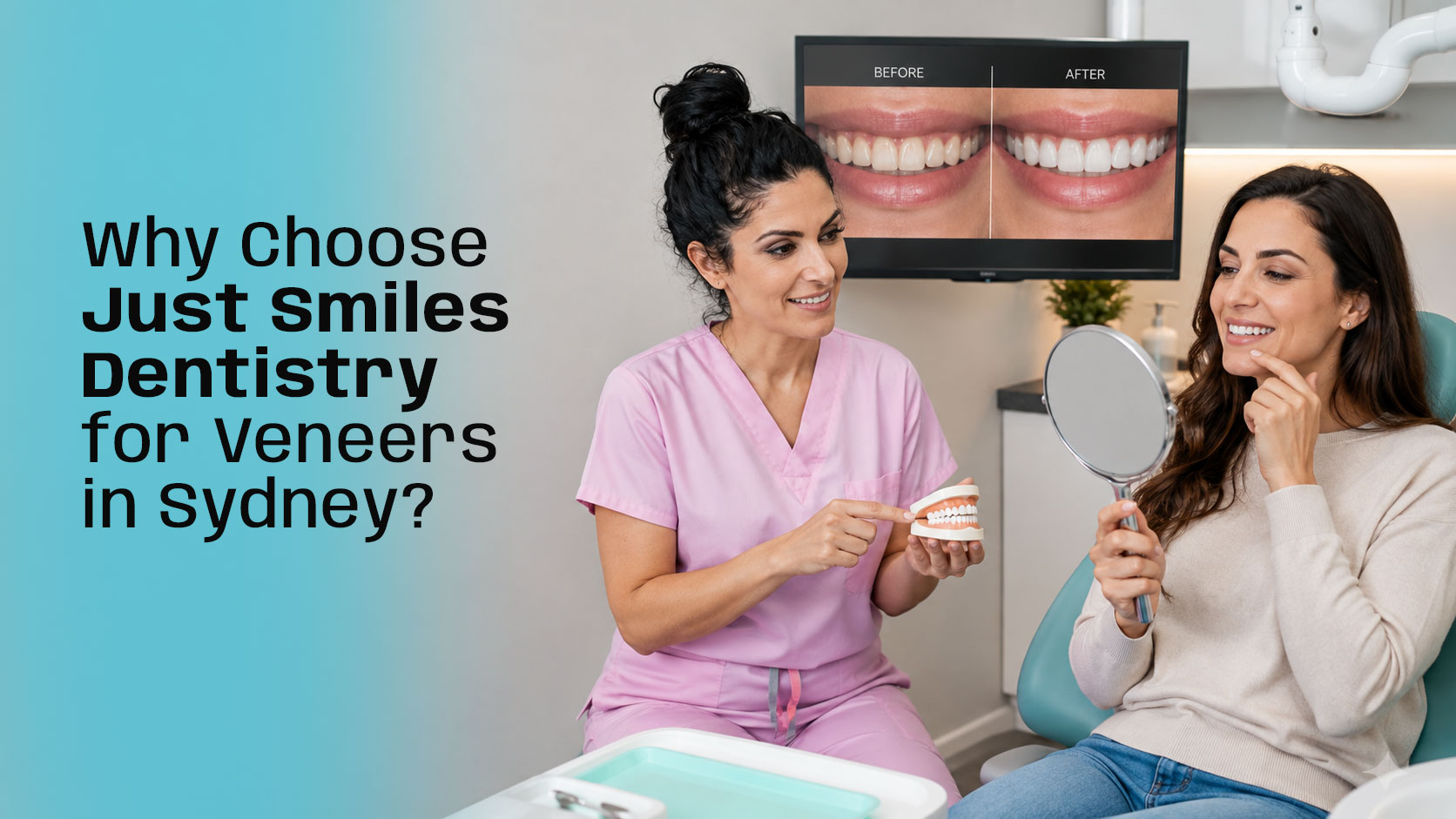
Why Choose Just Smiles Dentistry for Veneers in Sydney?
At Just Smiles Dentistry, every treatment plan begins with a thorough check of your gums, enamel and bite before any cosmetic conversation takes place, so you get an honest answer about whether veneers alone will work or whether alignment should come first. Our approach starts with a personalised smile design rather than a generic template, using digital smile design and intraoral scanning technology so you can see a preview of your results before treatment even begins.
Treatment is led by Dr Nicole Saba, an experienced cosmetic dentist, and that experience shows in the small details that matter most, such as shade matching, tooth proportion and getting your bite right so your veneers last. Every patient is treated with care and honesty, and our team is always ready to answer questions about suitability, cost and expected outcomes. We can also combine Invisalign®, whitening and composite veneers into one coordinated plan when that gives you a better result, and our conveniently accessible location makes it simple to attend every appointment.
If you are ready to explore your options, we would love to help you achieve a natural, confident smile. Book an appointment with our friendly team today, or call us on 1300 585 857 to get started.
Final Thoughts
Veneers are a genuinely excellent cosmetic option for people with mildly crooked teeth, and they can also improve chips, staining, uneven tooth shapes and small gaps between teeth. More significant misalignment or bite problems usually need to be addressed with Invisalign® or another form of orthodontic treatment first, and in many cases, a small number of veneers are added afterwards simply to refine the final result. The only reliable way to know which path is right for your smile is through a professional assessment with a qualified dentist, since every mouth is different and deserves a treatment plan built around its own individual needs.
Frequently Asked Questions
- Can veneers straighten crooked teeth?
Not in a literal sense, because veneers do not move teeth into a new position. Instead, they cover the front surface of the tooth so that mildly crooked or uneven teeth appear straighter. - Are veneers suitable for severely crooked teeth?
On their own, they generally are not suitable for severe crowding or bite problems, since these issues should be corrected with orthodontic treatment first. Placing veneers over badly misaligned teeth tends to look unnatural and wear poorly over time. - Should I choose veneers or Invisalign® for crooked teeth?
This really depends on the nature of your concern, since veneers suit cosmetic issues and mild misalignment, while Invisalign® is designed to physically move teeth into a healthier position. A consultation with your dentist will help make the right path clear for your particular smile. - How long do porcelain veneers typically last?
With good care, porcelain veneers often last somewhere between ten and fifteen years, and research suggests that a strong majority remain fully functional even after a decade of everyday use.
About The Author